History of the Stanley Cup
It started on March 18, 1892, at a dinner of the Ottawa Amateur Athletic Association. Lord Kilcoursie, a player on the Ottawa Rebels hockey club from Government House, delivered the following message on behalf of Lord Stanley, the Earl of Preston and Governor General of Canada:
I have for some time been thinking that it would be a good thing if there were a challenge cup which should be held from year to year by the champion hockey team in the Dominion (of Canada).
There does not appear to be any such outward sign of a championship at present, and considering the general interest which matches now elicit, and the importance of having the game played fairly and under rules generally recognized, I am willing to give a cup which shall be held from year to year by the winning team.
Shortly thereafter, Lord Stanley purchased a silver cup for the equivalent of $48.67, and set rules for the competition, including rules about the winning team getting their names engraved on the silver ring, and the one cup being passed from winning team to winning team.
The first winner of the Stanley Cup was the Montreal Amateur Athletic Association (AAA) hockey club, champions of the Amateur Hockey Association of Canada for 1893. Lord Stanley returned to his native England in the midst of the 1893 season, never witnessing a championship game nor attending a presentation of his trophy.
The trophy has since been awarded every year, with the exception of 1919, when an influenza epidemic forced the cancellation of the finals. The NHL took control of the cup after the 1926 season, and since then the cup has traveled millions of miles around the world and had more than 2,000 names engraved. Unlike league trophies in most sports, the Stanley Cup is a true traveling trophy, meaning that each year, the trophy is passed to the winning team. Since 1995, each player gets to take the trophy for a few days during the offseason, leading to some interesting stories for the cup–including time in strip clubs, being used as a beer cup, getting lost, and even ending up at the bottom of a swimming pool.
The Original Cup
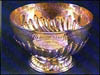 The bowl that currently sits atop the Stanley Cup is a carefully constructed replica of the original bowl purchased by Lord Stanley in 1893. The original trophy was retired in 1969 because it had become brittle, but can still be seen at the Hockey Hall of Fame in Toronto.
Growth of the Cup
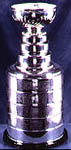 In the early days, players added their names to the trophy by scratching them onto the bowl with a knife or a nail. From the 1890s to the 1930s, various bands were added to the bottom of the bowl to hold the names of the winning teams and their players. Throughout this time, the appearance of the Cup kept changing almost from year to year. In 1939, the Stanley Cup was given a standardized form as a long, cigar-shaped trophy. It stayed this way until 1948, when it was rebuilt as a two-piece trophy with a wide barrel-shaped base and a removable bowl and collar. The modern one-piece Cup was introduced in 1958.
Related Manlyweb Content
Stanley Cup Winners
Recent Comments